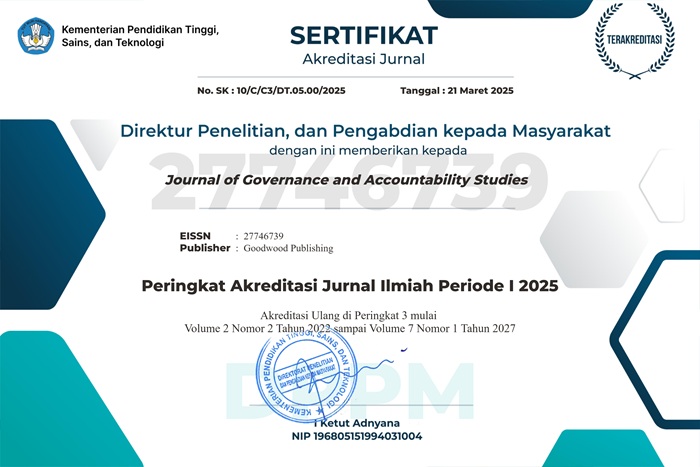
The Journal of Governance and Accountability Studies (JGAS) is an online peer-reviewed, open access scholarly journal, which publishes critical and original analysis from researchers and academic practitioners on various social, political and government issues. JGAS welcomes high-quality manuscripts covering original research articles, review articles, book reviews, case reports, and discussions aimed at advancing both theoretical and practical development on areas of governance and accountability issues.
Published
2026-01-06
Purpose: This study investigates the nature, magnitude, and potential remedies for electoral violence in Nigeria, Ghana, and Kenya, with the aim of offering evidence-based insights for mitigating its occurrence.
Methods: A descriptive survey design was adopted. Data were collected using the Comprehensive Electoral Violence Questionnaire (r = 0.82), which was developed to measure stakeholders’ perceptions of electoral violence. A total of 1,800 participants (600 from each country) responded to items addressing the nature, scale, and possible solutions to electoral violence in the three countries.
Results: The findings revealed that the most prominent features of electoral violence include poor civic education, the misuse of state resources by incumbent governments, and the influence of foreign actors. The magnitude of violence is reflected in the widespread use of firearms, the involvement of large, organized groups, and the targeting of specific ethnic or religious communities. Key remedies identified were ensuring judicial independence for peaceful resolution of disputes, promoting civic education, and strengthening electoral commissions.
Conclusions: Electoral violence in Africa is multifaceted, deeply rooted in governance weaknesses, and exacerbated by systemic and external factors. Addressing this requires institutional reforms, public education, and impartial legal mechanisms.
Limitations: The study relied solely on self-reported data from selected stakeholders, which may have introduced perception bias and limited generalizability.
Contributions: This study offers comparative insights into three African democracies and provides actionable policy recommendations for reducing electoral violence and strengthening democratic resilience.
Purpose: The find out whether there is dissensus and its implications for the experience of policy failure. Analysis of these factors is an important note in the anticipatory government framework for the future of the policy.
Methodology/approach: Descriptive research with a qualitative approach and analysis. Primary data was obtained by conducting interviews with several informants. Secondary data was obtained from tracing reports and research and regulations related to the topic of collaborative governance challenges that are directly related to the research.
Results/findings: The results showed that dissensus occurred from the planning to the implementation stages. Furthermore, the lack of guarantees that collaborators' actions corresponded with the consensus led to dissensus. This condition allowed collaborators to pursue self-interests, viewing collaboration as a means to achieve economic objectives and mutually strategize.
Conclusions: The involvement of the parties with the consensus before the policy is implemented still leaves the challenge of the dissensus which has the potential to be a factor that influences the failure of the policy.
Limitations: This research is based on the experience of policy failures several years ago. Therefore, in the current situation, it is very possible that there will be a change in collaborators.
Contribution: By analyzing the factors that lead to policy failure, this research offers important insights into the challenges faced in multi-stakeholder decision-making processes. The findings are expected to serve as a reference for policymakers to develop more effective strategies for government and stakeholder collaboration in the future.
Purpose: This study aimed to assess the effectiveness of a voter education instructional package in improving the Knowledge, Attitudes, and Practices (KAP) framework for preventing electoral violence among youths in Ondo City, Nigeria.
Methodology/approach: A quasi-experimental design with a pretest-posttest control group approach was adopted. The sample consisted of 183 youths of voting age, selected from four communities. The experimental group received a structured voter education package over eight weeks, while the control group was exposed to traditional instructional techniques. Data were collected using five validated questionnaires. ANCOVA was used for analysis.
Results/findings: The study found that the treatment significantly improved participants' knowledge (F = 28.275, p < 0.05) and practice (F = 21.810, p < 0.05) regarding electoral violence prevention. However, there was no significant effect on attitude (F = 0.195, p > 0.05). Gender did not have a significant impact on any of the KAP components (p > 0.05).
Conclusions: The voter education package significantly enhanced knowledge and practice among youths in Ondo City, making it a promising strategy for preventing electoral violence. However, it did not significantly change attitudes, suggesting that attitude transformation requires more extensive engagement.
Limitations: The study focused on a specific region, and the sample size was limited to one state. Future studies should explore other regions and implement longitudinal assessments.
Contribution: The study contributes to the field by offering an evidence-based voter education package that can be adopted in Nigeria and other developing democracies to mitigate electoral violence among youth.
Purpose: Sustainability reporting has been frequently used globally to provide corporate transparency to stakeholders on environmental, social, and governance matters. Therefore, this study investigates how audit committee attributes act as moderators on sustainability reporting and firm performance relationships in India.
Research Methodology: This research employs the DWH Test for Endogeneity and OLS regression on data collected from the listed BSE 500 companies, with 840 observations from March 2019 to 2024. It takes ESGScore as independent, ACMeet and ACSize as moderators, and RONW and Tobin’s q as dependent variables.
Results: The empirical results indicate a significant positive association between firm performance and ESG reporting. They also show a moderation effect of AC Size (p-value-0.06) and AC Meeting (p-value-0.00) on the relationship between RONW and ESG, implying that good audit management increases the benefits of sustainability projects.
Conclusions: It indicates the high trust of stakeholders which improves corporate reputation, creates brand value and drive innovation to gain competitive advantage and long-term growth which leads to positive IRR and helps in managing the various potential risks causing by environmental and societal factors.
Limitations: This study considers only two AC attributes and depends on secondary ESG data, thus there may be chance of potential bias and unobserved variables.
Contribution: This research contributes in terms of describing the deeper insights into governance quality by introducing AC size and AC meetings as moderators on ESG reporting and FP relationship.
Purpose: The aim of this research is to compile data on the potential tax of hotels, restaurants, and entertainment in Bangka Regency in 2023.
Research Methodology: We used in this study are primary and secondary data. The researcher used stratified random sampling for fifty-one Local Taxpayers in Bangka Regency. Data analysis employed a micro approach to obtain target projections and potential local tax revenue projections in Bangka Regency, specifically for Certain Goods and Services Tax (Restaurant Tax, Hotel Tax, and Entertainment Tax).
Results: Research findings indicate that it is possible to improve the realization of Restaurant Tax revenue in the future. The biggest potential for Hotel from 4-star hotels.About 11% of Entertainment Tax potential has been realized, so it is very likely to improve the realization of Entertainment Tax revenue in the future.
Conclusions: Hotel and restaurant taxes fall into the developing category, while entertainment tax falls into the backward category. The growth projections for hotel and restaurant taxes can be further improved in the future. Innovative programs and more attention to local taxes in the backward category are efforts to enhance regional tax revenue.
Limitations: This research is limited to examining three studies of local tax objects in Bangka Regency.
Contribution: For future researchers, it is recommended to further examine the aspects of compliance of Local Taxpayers and to delve deeper into other Local Tax objects not included in this study.
Purpose: This study aims to examine the effects of the tax amnesty program, income, moral obligation, and access to tax services on motorcycle taxpayer compliance in Timor Tengah Utara (TTU) Regency, a border region with relatively low tax compliance.
Research Methodology: A quantitative approach was employed using a survey method. The study involved 100 respondents selected through the Slovin formula. Primary data were collected via structured questionnaires and analyzed using multiple linear regression.
Results: The findings show that, simultaneously, the four variables significantly influence taxpayer compliance. Partially, the tax amnesty program, income, and moral obligation have a positive and significant effect, while tax access has a negative and significant effect on compliance.
Conclusions: Taxpayer compliance in TTU Regency is influenced not only by economic capacity but also by moral awareness and accessibility to tax services. Policies that optimize tax amnesty programs, expand digital-based tax services, and strengthen moral and social education grounded in local culture can enhance voluntary tax compliance.
Limitations: The study is limited to motorcycle taxpayers in TTU Regency and uses cross-sectional survey data, which may not capture changes in behavior over time.
Contribution: This study contributes to the understanding of tax compliance behavior in border regions, offering practical insights for local governments and policymakers to improve regional revenue collection through culturally sensitive and accessible tax policies.
Google Scholar
Garuda
Sinta